
Reflecting growing prosperity, India's per capita income grew by 15.6 per cent to Rs 53,331 per annum in 2010-11, crossing the half-a-lakh rupees mark for the first time, according to government data.
Reflecting growing prosperity, India's per capita income grew by 15.6 per cent to Rs 53,331 per annum in 2010-11, crossing the half-a-lakh rupees mark for the first time, according to government data.

The Reserve Bank is likely to cut the repo rate by 25 basis points (bps) after the Budget.

The first economic readings to be published in 2015 will be out on Monday, when the government releases industrial output data for November and the consumer price index for December.

Continuing the downward trend, retail inflation fell to a five-month low of 4.31 per cent in January, mainly due to a decline in the prices of vegetables, eggs, and pulses. The Consumer Price Index-based retail inflation was 5.22 per cent in December and 5.1 per cent in January 2024. The previous low inflation was in August 2024 at 3.65 per cent.

"We are extremely happy to know that according to Central Statistic Office reports the state has achieved a growth rate of 16.59 per cent. . . It's a miracle," Kumar told reporters in Patna while releasing performance card of his government for the past 55 months.

rediffGURU Aasif Ahmed Khan counsels students on the best career options in tech and engineering.

'It is for the first time in Independent India that collection of information on caste is being done.'

The earlier high was in January this year at 5.07 per cent.

The manufacturing sector, which constitute more than 77 per cent of the index, recorded a growth of 5.2 per cent in April, up from 2.9 per cent in the year ago month.
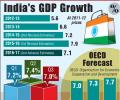
'I expect fourth quarter GDP growth to be sharply down.' 'I would imagine it would shave off at least one percentage point, if not more, as compared to the third quarter.'

Economists, however, caution against interpreting the data as a broad-based revival

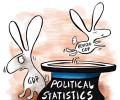
108 economists, social scientists said it was imperative that agencies like CSO and NSSO are not subject to political interference.

Soaring vegetable prices pushed the retail inflation rate to a nine-month high of 5.49 pr cent in September, according to government data released on Monday. The consumer price index (CPI)-based retail inflation rate was 3.65 per cent in August and 5.02 per in September 2023. The previous high inflation rate was witnessed in December 2023 at 5.69 per cent.

On his 200th birth anniversary, Utkarsh Mishra traces the life, thought, and legacy of Dadabhai Naoroji, the Grand Old Man of India.

According to the Central Statistics Office data, the jump in the retail inflation based on Consumer Price Index was mainly due to rise in prices of kitchen items like vegetables, meat and fish.

GDP growth during 2018-19 is estimated at 7 per cent as compared to 7.2 per cent in 2017-18.

Headline growth was quite weak heading into the Covid period but averaged 6.4 per cent and 6.7 per cent in the five years between FY16 and FY20 for GVA and GDP respectively, points out Abhishek Upadhyay.

Andhra Pradesh posted 8.14% consumer inflation in October.
The rate of price rise in the protein rich items like eggs, milk and other products too moderated in March as against the previous month.

According to Central statistics office press note, GDP at current prices in Q1 of 2015-16 is estimated at 32.43 lakh crore, as against 29.80 lakh crore in Q1 of 2014-15, showing a growth rate of 8.8 percent.

The rate of price rise for consumer foods eased to 4.7 per cent in January, from 4.96 per cent in December.

The rate of price rise in the food basket contracted by 0.86 per cent in October compared to 0.51 per cent rise in September

The Reserve Bank of India on Friday revised upwards the GDP growth projection for the current fiscal to 7.2 per cent from 7 per cent on rising private consumption and revival of demand in rural areas. Unveiling the bi-monthly monetary policy, RBI Governor Shaktikanta Das said estimates released by the National Statistical Office (NSO) placed India's real gross domestic product (GDP) growth at 8.2 per cent in 2023-24. "During 2024-25 so far, domestic economic activity has maintained resilience," he said, adding that manufacturing activity continues to gain ground on the back of strengthening domestic demand.

India's industrial production growth slowed to 3.8 per cent in January, while the February retail inflation at 5.09 per cent remained within the Reserve Bank's comfort zone for the sixth straight month, according to the latest government data. Growth in factory output, based on the Index of Industrial Production (IIP), slowed to 3.8 per cent in January 2024, mainly due to poor performance of manufacturing, mining and power sectors, according to the data released by the Ministry of Statistics & Programme Implementation.

Growth in 2012-13 slipped to a decade-low of 4.5 per cent. The economy expanded 4.6 per cent in the first half (April-September) of this financial year.

Securing the GDP estimates a month in advance would be a challenge and the government should take the Central Statistics Office on board before embarking on the new schedule for Budget presentation

On overall basis, the inflation in the food segment increased to 4.42 per cent in November as compared to 1.9 per cent in the preceding month.

'We will have to wait for one more year to cross the 7% mark, which should be possible in the absence of any disruptive reform,' points out CARE Ratings Chief Economist Madan Sabnavis.
Earlier, the CSO in its advance estimate had pegged the GDP growth rate for 2018-19 at 7.2 per cent.
Slowdown in industrial production notwithstanding, a marginal increase in inflation raised the clamour for another round of rate cut by the Reserve Bank on April 4 to boost economic activity.

Retail inflation declined to a five-month low of 4.85 per cent in March mainly due to cooling food prices, inching towards the Reserve Bank's target of 4 per cent, according to official data released on Friday. The Consumer Price Index (CPI) based retail inflation was 5.09 per cent in February and 5.66 per cent in March 2023. Previously, CPI-based inflation was the lowest at 4.87 per cent in October 2023.

Items such as cereals and products, meat and fish, oils and fats became cheaper

Niti Aayog vice-chairman Rajiv Kumar said that the two major constraints being faced by the investors are less availability of finance and high interest rates.
The GDP growth is estimated to come at the "deceptively high" level of 20 per cent for the April-June 2021 quarter but is far below the same in the pre-COVID times, rating agency Icra said on Wednesday. Icra said the low base of the last year, when the GDP had contracted by close to 24 per cent, "conceals" the impact of the second wave of COVID-19 infections. Economic activity is boosted by robust government capital expenditure, merchandise exports and demand from the farm sector, it said, estimating the GDP to grow by 20 per cent and the gross value added (GVA) will register a growth of 17 per cent for the June quarter.

The rate of price rise in the vegetable segment almost doubled to 7.47 per cent as against 3.92 per cent in September.
Retail inflation fell to an 11-month low of 5.88 per cent in November, mainly due to softening prices of food items, official data showed on Monday. This is the first time in 11 months that the retail inflation print has come within RBI's tolerance band of 4 (+/- 2) per cent. The consumer price index (CPI) based retail inflation was 6.77 per cent in October 2022, and 4.91 per cent in November last year.

India will drive growth in the Asia-Pacific (Apac) region as the growth engine is likely to shift from China to South and Southeast Asia in the coming years, S&P Global Ratings said in a report on Tuesday. The rating agency's report projected China's growth to slow down to 4.6 per cent by 2026 from an estimated 5.4 per cent in 2023. India is likely to clock 7 per cent economic growth from 6.4 per cent estimated for 2023.

India's monthly per capita income, the measure of standard of living, is likely to be at Rs 7,378.17.

While data can empower communities, it reinforces identities, making local politics more caste-centric, with decisions increasingly contested on the grounds of representation.
Such dynamics could lead to shifting alliances and, in the worst case, local governance getting paralysed as each group demands proportional power-sharing, explain Amitabh Kundu and Mehebub Rahaman.
